










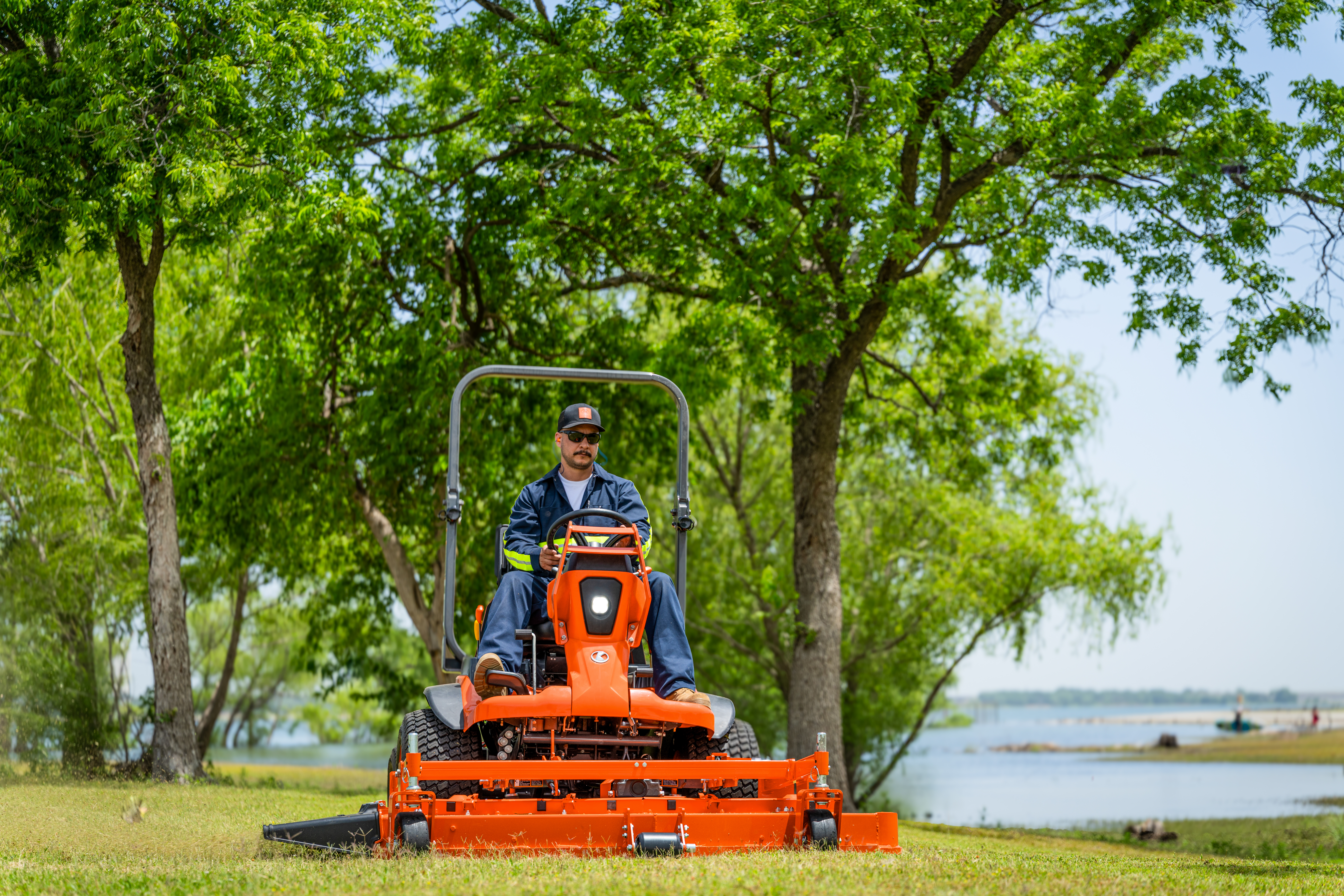


Whether you are a landscaping contractor, the owner of a large property, or simply passionate about a perfectly manicured lawn, choosing the right commercial mower always raises the same questions.
Two Experts, Genuine Knowledge Of The Quebec Landscape
To answer these questions, we turned to the expertise of Stephen Jarrabet, product specialist in Montreal, and Jean-Philippe Girard, product specialist in Cowansville and Sutton.

Together, they have decades of experience in sales, parts, and services. They understand the realities of Quebec’s landscape, whether for commercial contracts or demanding semi-professional and residential use.
We asked them the questions that customers really ask.
- Which commercial mower offers the best value for money for professional use ?
- Diesel or gas: which should you choose for a commercial mower ?
- Zero-turn or front mount mower: which is more productive ?
- What are the annual maintenance costs for a commercial mower ?
- Which brands of commercial mowers are the most reliable in Canada ?
Let’s go!
1. Which commercial mower offers the best value for money for professional use ?
According to Stephen and JP, value for money depends above all on:
- the number of hours worked
- the type of terrain
- the type of contracts
« An owner of a steeply sloping 2-acre plot will not make the same choice as a contractor who mows dozens (or hundreds) of acres per week. »
— Jean-Philippe
Before shopping, it is essential to assess your actual usage. Here are the types of mowers according to category.
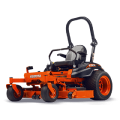
Mowers – Z Series (gas)
Ideal for a variety of uses, offering an excellent balance between cost, performance, and durability.
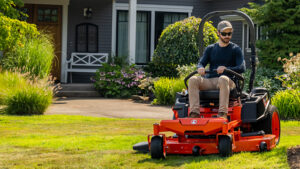
Z200 – Residential axis
Easy to handle, maneuverable, and comfortable. Perfect for regular maintenance, even around obstacles.
- Power: 21.5 to 26.0 HP
- Deck size: 42 to 54 inches
- Mower type: Side discharge
- Average size: 1 to 5 acres
- Fuel: Gas

Z400 – Residential and semi-commercial axis
More robust and stable as the hours grow longer. A versatile mower that lets you get more done without sacrificing comfort.
- Power: 22.0 to 26.0 HP
- Deck size: 48 to 60 inches
- Mower type: Side discharge
- Average size: 1 to 5+ acres
- Fuel: Gas
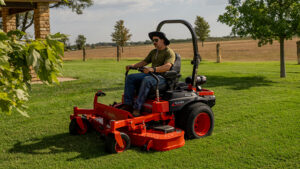
Z700 – Semi-commercial and commercial axis
Designed to work hard, for long periods of time and often. Consistent performance, lasting comfort and excellent productivity.
- Power: 23.0 to 29.5 HP
- Deck size: 48 to 60 inches
- Mower type: Side discharge
- Average size: 1 to 5+ acres
- Fuel: Gas
« Some commercial customers combine a Z700 for the main cut and a SZ-36 for tighter areas or finishing touches.»
— Stephen
Mowers – ZD Series (diesel)
Recommended as soon as the hours start to add up. 100% Kubota commercial models, built to last.
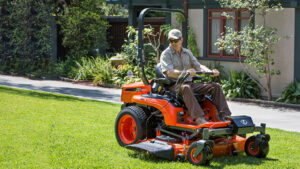
ZD1000
Solid, stable, and reassuring machine. Clean cut and consistent comfort, even during long days.
- Power: 19.3 to 21.6 hp
- Deck size: 48 to 60 inches
- Mower type: Side discharge
- Average size: 1 to 5+ acres
- Fuel: Diesel
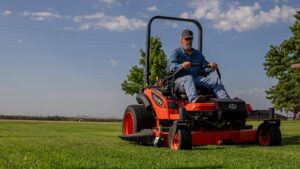
ZD1200
Constant power, excellent efficiency, and a choice of 60-inch or 72-inch PRO decks. Adaptable to suit your job sites.
- Power: 23.3 hp
- Deck size: 60 to 72 inches
- Mower type: Side or rear discharge
- Average: 5+ acres
- Fuel: Diesel
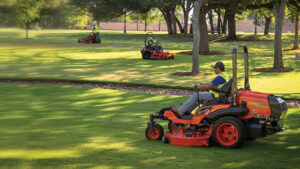
ZD1600
The high-end model. More power, more space, more comfort. Ideal for covering large areas without unnecessary fatigue.
- Power: 30.8 hp
- Deck size: 60 to 72 inches
- Mower type: Side or rear discharge
- Average: 5+ acres
- Fuel: Diesel
« I love this product line because it is 100% Kubota from top to bottom. »
— Jean-Philippe
Mowers – ZG Series (gas)
Zero-turn mowers powered by gasoline, also entirely designed and manufactured by Kubota.
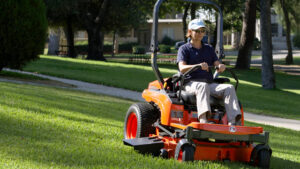
ZG200
Easy to use, stable, and smooth. Precise cutting and confidence from the very first passes.
- Power: 21.1-26.0 HP
- Deck dimensions: 48–54–60 in.
- Mower type: Side discharge
- Average (hr): 1–5+ acres
- Fuel type: Gas
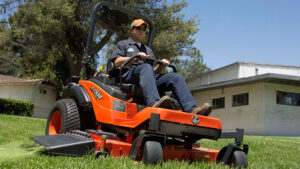
ZG300
More powerful and robust for demanding terrain. A reliable machine when the work gets tougher.
- Power: 27.0 hp
- Deck size: 60 in.
- Mower type: Side or rear discharge
- Average (hr): 1-5+ acres
- Fuel type: Gas
- KUBOTA gas engine
SZ Series (gas)
Semi-commercial and commercial use. The SZ Series is a fast, maneuverable, and comfortable stand-on mower. It is designed for professionals who want to work efficiently, even in tighter areas, while maintaining good control and consistent performance.
“Multiple units can be loaded onto a single trailer, a real advantage for teams who want to maximize space and productivity in the field,” says Stephen.
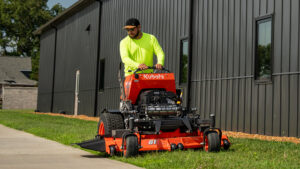
SZ Series
- Power: 19.0-26.0 hp
- Deck size: 36 – 48 – 52 – 61 in.
- Mower type: Side discharge
- Average (hr): 2.5-4.5 acres
- Fuel type: Gas
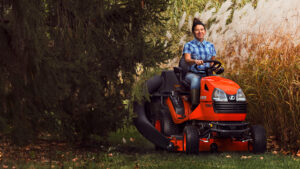
T90 Series (gas)
Residential use. Comfortable, easy to use, and stable. An effective solution for pleasant and consistent mowing.
- Power: 21.5 HP
- Deck size: 42-48 in.
- Average (hr): up to 2 acres
- Fuel type: Gas
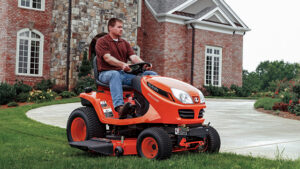
GR Series (diesel/gas)
Residential and semi-commercial use. Exceptional maneuverability thanks to Glide Steer technology. Tight turns, lawn protection, and excellent traction, even on difficult terrain.
- Power: 17.0-20.5 hp
- Deck size: 48-54 in.
- Average (hr): up to 3 acres
- Fuel type: Gas and Diesel
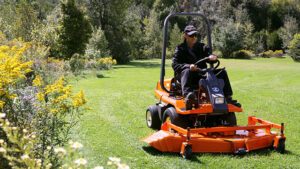
GF Series (diesel)
Residential and semi-commercial use. Front deck mower, compact, agile, and economical. Ideal for maneuvering around landscaping features with minimal maintenance.
- Power: 16.6 hp
- Drive system: 2WD or 4WD
- Deck dimensions: 48-60 in.
- Average (hr): 1-5+ acres
- Fuel type: Diesel
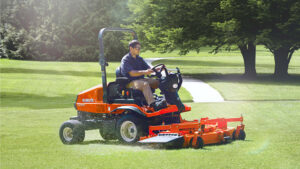
F Series (diesel)
Powerful, precise, and highly productive. Front cutting deck. Excellent visibility, high comfort, and proven reliability for residential and commercial use.
- Power: 23.3 hp to 36.9 hp
- Drive system: 2WD or 4WD
- Deck size: 60-72 in.
- Average (hr): 5+ acres
- Fuel type: Diesel
Advice From Our Experts
The common ground between Stephen and JP is clear: avoid oversizing, without underestimating the actual intensity of the work. In the field, they often see customers buying machines that are too powerful for their needs… or, conversely, neglecting certain important specifications at the time of purchase.
That’s why their approach is always the same: take the time to listen, ask the right questions, and fully understand the customer’s situation. Number of hours, acreage, type of terrain, future projects—every detail counts when recommending the most suitable, durable, and cost-effective machine.
Another tip is to understand the difference between 100% Kubota models and models with external components.
According to Stephen and JP, this is a key point that many customers don’t realize at first, but it makes a real difference in the long run.
100% Kubota models—such as the ZD and F series—are designed, manufactured, and assembled with Kubota components, from the engine to the transmission and chassis. This consistency in manufacturing translates into greater durability, increased reliability, and optimal integration between different parts. These machines are designed for more intensive use, with well-defined maintenance intervals and proven longevity. We are talking here about Kubota’s high-end range, often favored by contractors who work hard and long hours with their equipment.
Kubota models with components from other manufacturers—such as the Z, T, and GR gas series—remain highly efficient and reliable, but with a more economical approach. Kubota integrates engines or transmissions from recognized manufacturers to offer excellent value for money. These models are ideal for demanding residential and semi-commercial use, or for contractors looking for an efficient machine without necessarily going for the top of the commercial range.
In summary, it is not a question of “good or bad choice,” but of choosing the right category based on the intensity of use, the number of hours, and the reality of the work to be done.
2. Diesel Or Gas: Which One Should You Choose?
This is one of the first questions entrepreneurs ask, and there is no universal answer. According to Stephen and JP, the choice between diesel and gasoline depends mainly on frequency of use and willingness to invest in the long term.
Gas models are often preferred for their more affordable purchase price and simplicity. They are well suited for demanding residential use and semi-commercial operations, where the mower does not accumulate hundreds of hours per season. On the other hand, maintenance is more frequent, generally around every 100 hours of use.
Diesel, on the other hand, is clearly aimed at users who work a lot. Maintenance intervals are longer—often between 200 and 250 hours—and fuel consumption is lower. For contractors who want to maximize their time in the field and reduce downtime in the garage, diesel quickly becomes a logical and cost-effective choice.
In summary:
Gas
- More frequent maintenance (approximately 100 hours)
- Lower purchase cost
- Ideal for semi-commercial use
Diesel
- Extended maintenance intervals (200 to 250 hours)
- Reduced fuel consumption
- Designed for heavy commercial use
In the long term, diesel often becomes the most cost-effective choice
3. Zero-Turn Or Front Mount Mower (4×4)?
Here again, Stephen and JP are unanimous: productivity depends directly on the type of terrain and the business model. There’s no getting around it!
Zero-turn mowers are known for their speed and maneuverability. They excel around obstacles such as trees, flower beds, and landscaping features. For most landscaping contracts, especially in standard residential or commercial settings, they are often the most efficient tool for saving time during the summer season.
The front-mounted mower (4×4), mounted on a tractor—often with all-wheel drive—provides increased stability on more complex terrain. It is also appreciated for its versatility, as it can be used year-round for other tasks such as snow removal. Many contractors end up using both types of machines, depending on the contract and conditions.
In summary:
- Zero-turn : speed and maneuverability, ideal for most landscaping jobs
- Front Mount 4×4 : increased stability, four-season versatility
Several contractors combine the two depending on their contracts.
4. What Are The Annual Maintenance Costs?
On this point, both experts are keen to make one thing clear: there is no single figure. Maintenance costs vary depending on the intensity of use, the type of engine, and compliance with the manufacturer’s recommended maintenance schedule.
In practice, the first maintenance often comes around fairly quickly, at around 50 hours. After that, the intervals become longer: around 200 hours for engine oil and up to 400 hours for hydraulic oil on some diesel models. The more regularly the machine is serviced, the more reliable and efficient it will remain over time.
As Stephen and JP aptly summarize, a well-maintained machine may seem more expensive initially, but it often costs less over its lifetime.
5. Which brands are the most reliable in Canada?
Stephen and JP readily admit that they talk about what they know best. But their argument is based primarily on their experience in the field.
According to them, the reliability of a commercial mower cannot be measured solely on a technical data sheet. It can be seen in the consistency between the engine, transmission, and chassis, in the quality of the components, and in the ease of access to original parts. A machine designed from the outset for real commercial use suffers fewer breakdowns, stays in the field longer, and requires fewer unexpected stops.
For a landscaping contractor, this reliability translates into less wasted time, fewer emergency repairs, and greater profitability.
A Final Note On Buying A Commercial Mower
Thanks to Stephen’s field experience in Montreal and JP’s in Cowansville and Sutton, one thing is clear: the best commercial mower is the one that fits your business reality, not the one with the most horsepower or the highest price tag.
Take the time to carefully assess your needs. It’s a long-term investment.